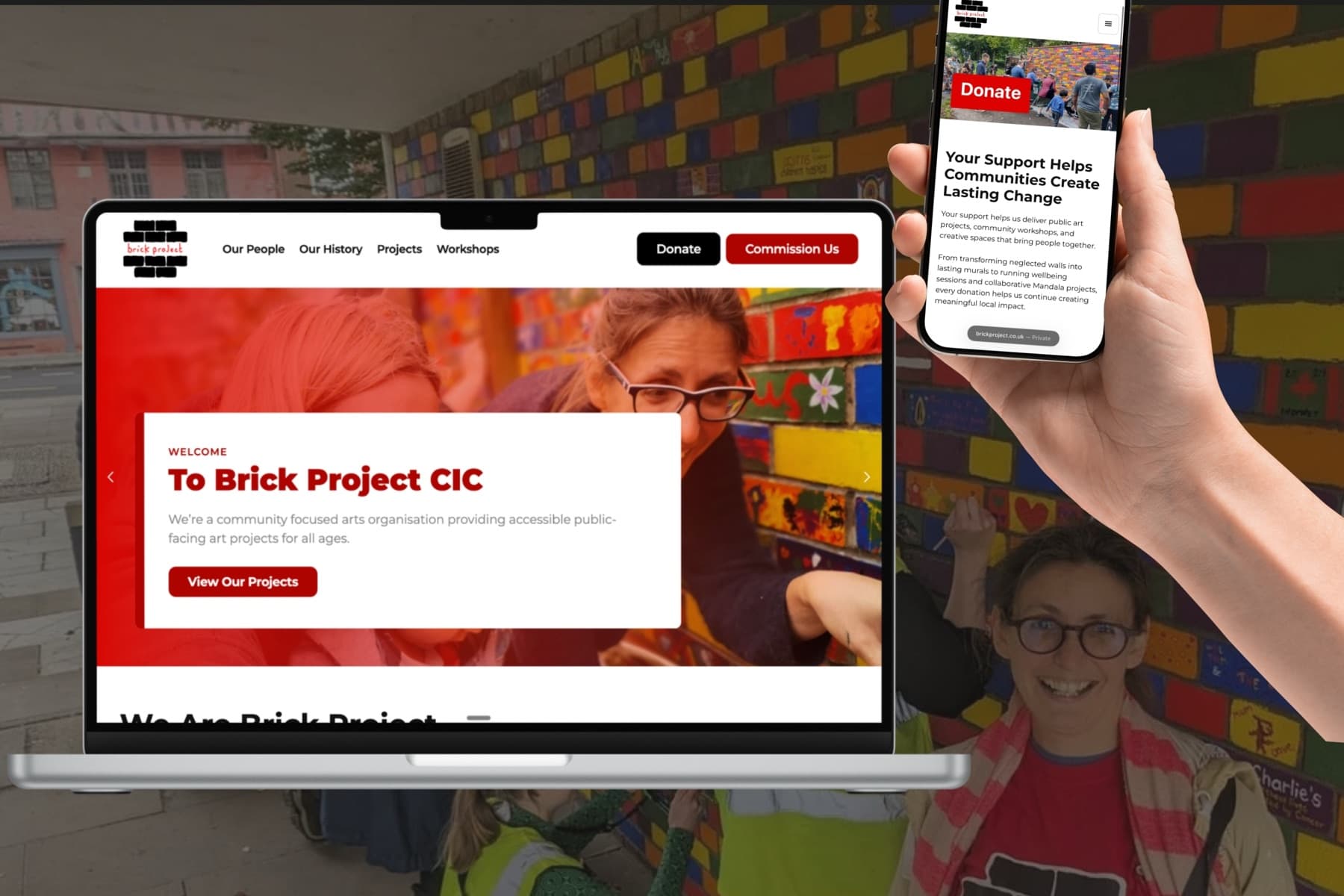
A community arts organisation that turns neglected walls into murals painted one brick at a time by the people who live beside them. The site had to win commissions, fill workshops and keep a record of who painted what.
- Sector
- Community arts
- Year
- 2026
- Services
- Web design, Development
The project
Brick Project CIC is a community interest company that makes public art with the people who live around it. On a Brick Project, every brick of a neglected wall is painted by a different person, to a theme the neighbourhood chooses. Its Mandala Projects do the same with painted wooden circles, set into a hexagonal frame that can travel to schools, festivals and community centres. It has been doing this since 2011, from a single wall in Bristol to projects across the UK and in Bulgaria.
Lune Studio designed and built Brick Project’s website.
The brief
Brick Project’s work is paid for in several ways at once. Councils, housing associations and arts funders commission the big walls, companies book painting workshops for their teams, and donors and crowdfunders cover what the grants do not.
Each of those people wants something different from the site. A commissioner wants to see what a finished project looks like and how the community was involved. A company wants to know what a workshop involves. A donor wants to know what their money pays for. And the people who painted a brick want to be able to find it again.
Making the case for a commission
The two formats each have a page explaining them in plain terms. One covers what a Brick Project is, how long one takes and how local people decide what goes on the wall. The other shows how a Mandala takes the same idea to places without a suitable wall.
Behind that sits the evidence. Every project since the first in 2011 has its own entry, listed with where it took place and when, and the history page tells the story year by year with the figures a funder looks for: 8,000 tiles in a Macclesfield underpass, and 3,125 bricks painted with seven Plymouth schools in seventeen days.
Commission Us sits in the header of every page, next to Donate.
Every brick, with a name
What sets Brick Project apart is that every piece belongs to somebody. Where a wall or a mandala has been photographed, its project page carries an interactive version of it: hover over a brick, or tap a circle, to see who painted it and what they called it. The Westgate Street wall in Gloucester lists hundreds of them.
That record is what makes a mural feel owned by the people around it. Anyone who took part can find their own brick, and their family’s, long after the painting days are over, and anyone thinking of commissioning a project can see how many people took part in the last one.
Workshops and donations
The workshops page sets out the three formats a company can book, from a drop-in painting session to a full Brick Project on a wall at its own premises, with an enquiry form at the foot of the page.
The donate page says what a donation pays for, from materials and facilitator time to youth sessions, and takes gifts through PayPal, with a link to the current crowdfunder beside it.
The organisation behind it
Brick Project’s credibility rests on its people and its track record, so both have room. Our People introduces the team, from the founding artist to the landscape archaeologist who works out who owns each wall. A resources page gathers the press coverage, radio interviews and films made about the work over the years.
The look
The design takes its colours from the logo, a stack of black bricks with the name hand-lettered in red. Red panels and buttons sit over photographs of people painting, and those photographs do most of the work of showing what it is like to take part.
The outcome
One site for everyone who keeps Brick Project going: the councils and funders who commission it, the companies that book it, the donors who support it, and the thousands of people whose paintings are now on a wall somewhere, many of them findable by name.
Thirty minutes, no charge. You will leave with an honest read on the problem and a clear recommendation, whether or not you work with us.