The UK’s leading military bereavement charity had outgrown its own name. The new site had to make clear that its support now reaches bereaved military families of any age, not only children.
- Sector
- Charity
- Year
- 2026
- Services
- Web design, Development, CMS build
The project
Scotty’s is the UK’s leading military bereavement charity, supporting families bereaved of someone who served in the British Armed Forces. It runs bereavement support, activity breaks, education grants and a community of people who have been through the same thing.
The charity began as Scotty’s Little Soldiers, supporting bereaved military children. It has since grown to support anyone bereaved of a serving parent, whatever their age, and the name had stopped describing what it did. Lune Studio rebuilt the website from the ground up to launch with the rebrand to Scotty’s Military Bereavement Charity, moving it from scottyslittlesoldiers.co.uk to a new home at scottys.org.uk.
The brief
The old site had been outgrown in the same way the old name had. It spoke to children and to the adults looking after them, and it left a bereaved twenty-two-year-old or a bereaved adult with nowhere obvious to see themselves. The first job of the new site was to make the wider remit obvious on arrival, without anyone having to read an announcement about a rebrand to understand it.
That had to happen without unsettling the families already there. People who have known Scotty’s for years still arrive looking for the same programmes, and none of them should have to relearn the site because the name on it changed.
Underneath that sit several distinct support programmes, a corporate membership club, an events calendar, a newsroom that publishes several times a week, and the donations that pay for all of it. Alongside them is the most sensitive thing on the site: the application a bereaved military family fills in to join the community.
The approach
Support is organised twice over: by programme, and by who is asking. Smiles, Strides, Scotty Breaks and the charity’s bereavement support each have their own page, with eligibility and referral routes set out plainly. Running alongside them are three separate journeys for children under sixteen, young people aged sixteen to twenty-five, and adults over twenty-five, so the widened remit is something a visitor walks straight into rather than something they have to be told.
Every editorial part of the site is the charity’s to change. News, events, programme pages, partner listings and the membership club all sit in a content system the Scotty’s team edits themselves, and changes appear on the live site within a minute. Nothing routine needs a developer.
Joining the community
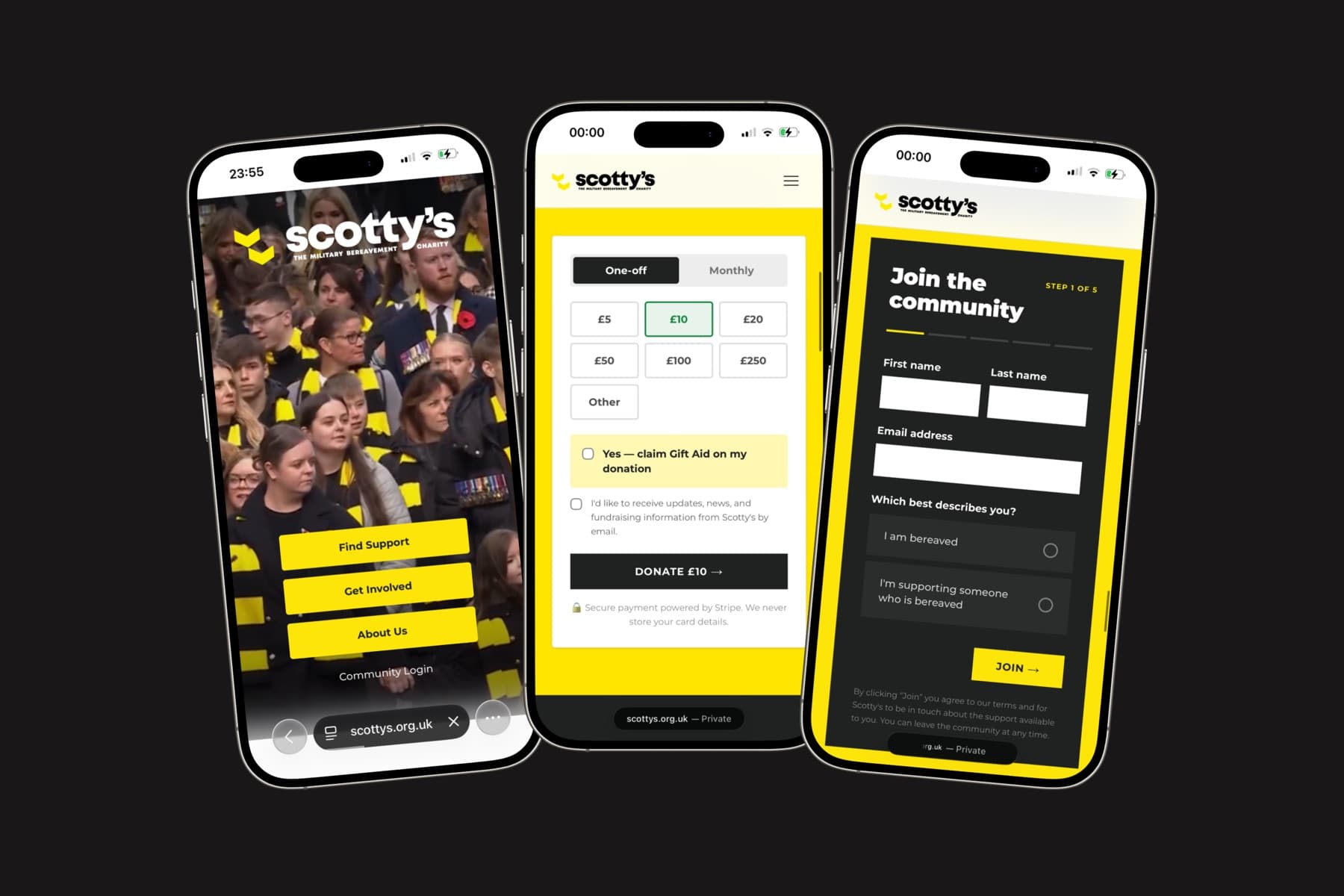
This is the part of the site that mattered most, and the part that took the most care. It is a ten-screen guided application that splits early into two paths, one for bereaved families and one for supporters, and checks eligibility on the third screen. Anyone who does not qualify is pointed towards other help rather than left at a dead end.
Questions about service history change depending on the answers before them, so nobody is asked something that does not apply to them, and nothing on the way through asks a grieving family for more than the charity actually needs.
Taking donations
Giving is the other thing the site has to be good at, so the donation form asks for one decision at a time. Whether the gift is one-off or monthly, how much it is, and whether Gift Aid applies. Set amounts are there for people who want to give and get on with their day, with a field for any other figure beside them.
Payments run through Stripe, so card details go to the payment provider and never touch the charity’s own site. The form says as much at the moment somebody is deciding whether to type a card number in, which is where reassurance is worth something. Gift Aid is claimed as part of the same step rather than chased afterwards, and that is often the difference between claiming it and not.
Feeding into the systems they already use
Scotty’s already runs on software that works for them, and none of this was worth building if it meant someone retyping the results into it. Donations, membership applications and supporter details are passed into the charity’s existing systems through their APIs, so a record arrives where the team already works, in the format that software expects.
That is the part of a build like this that decides whether it saves anyone any time. Collecting information on a website is the straightforward half. Handing it over cleanly to systems a charity already depends on, with no exports, no spreadsheets and nobody rekeying a form at the other end, is the half that has to be got right.
One dashboard instead of several
Understanding how the site was performing meant logging into several different tracking tools and piecing the answer together. We built Scotty’s their own analytics dashboard instead, so the whole picture sits in one place and the team can read it without needing anyone to interpret it for them.
It shows what is being visited, how many people are arriving and where they are coming from, what they are reading on, and how far through the membership application people get before they stop. That last one is the useful one: it tells the charity which screen is losing people, which is something no general-purpose tracking tool was ever going to answer.
It counts activity rather than following individuals. No names, email addresses or answers given to any form on the site are stored in it, which matters when the people using the site are bereaved families.
Carrying the new brand across the site
A rebrand only holds if it holds everywhere, so the new identity was applied across all forty pages rather than to a homepage with the old site sitting behind it. The site leads with photography of the Scotty’s community, and everything around it stays quiet so the pictures and the words are what people notice.
The subject matter set the tone. There is movement in the site, but it settles rather than announces itself, and nothing on the page competes with a family trying to work out whether the charity can help them.
The outcome
Forty pages and more than two hundred and thirty news articles, run day to day by the charity’s own team rather than by us. A corporate membership club with three tiers, partner listings and testimonials that Scotty’s edits itself. And a site that answers the question the rebrand raised — who is this for now — on the first screen, for a bereaved eight-year-old and a bereaved forty-year-old alike.
Thirty minutes, no charge. You will leave with an honest read on the problem and a clear recommendation, whether or not you work with us.