An independent Thai restaurant that started life as a market stall. The new site carries a long menu, takes table requests and hands the kitchen its own news page.
- Sector
- Hospitality
- Year
- 2026
- Services
- Web design, Development, Platform migration
The project
Two Thai is an independent Thai restaurant on China Street in the heart of Lancaster. It began in 2017 as a market stall run by two best friends, one of whom had moved from Thailand to Lancaster in 2015 to study for a master’s degree, and grew through market stalls and food events into a permanent kitchen serving Thai street food.
Lune Studio designed and built the restaurant’s website. The first version was assembled on an off-the-shelf website platform, which the restaurant had outgrown. This one was rebuilt from the ground up as a custom build and the site moved across to it, so what the site can do is decided by what the restaurant needs rather than by what a template allows.
The brief
Three kinds of trade come through the door: people eating in, people collecting, and people ordering for delivery. The site has to serve all three from a phone, usually while somebody is deciding where dinner is coming from tonight.
Most of that weight falls on the menu. Two Thai serves a long one, with dishes people cannot always picture from the name alone, and the kitchen needed to be able to change it without asking anybody for help.
A long menu that reads on a phone
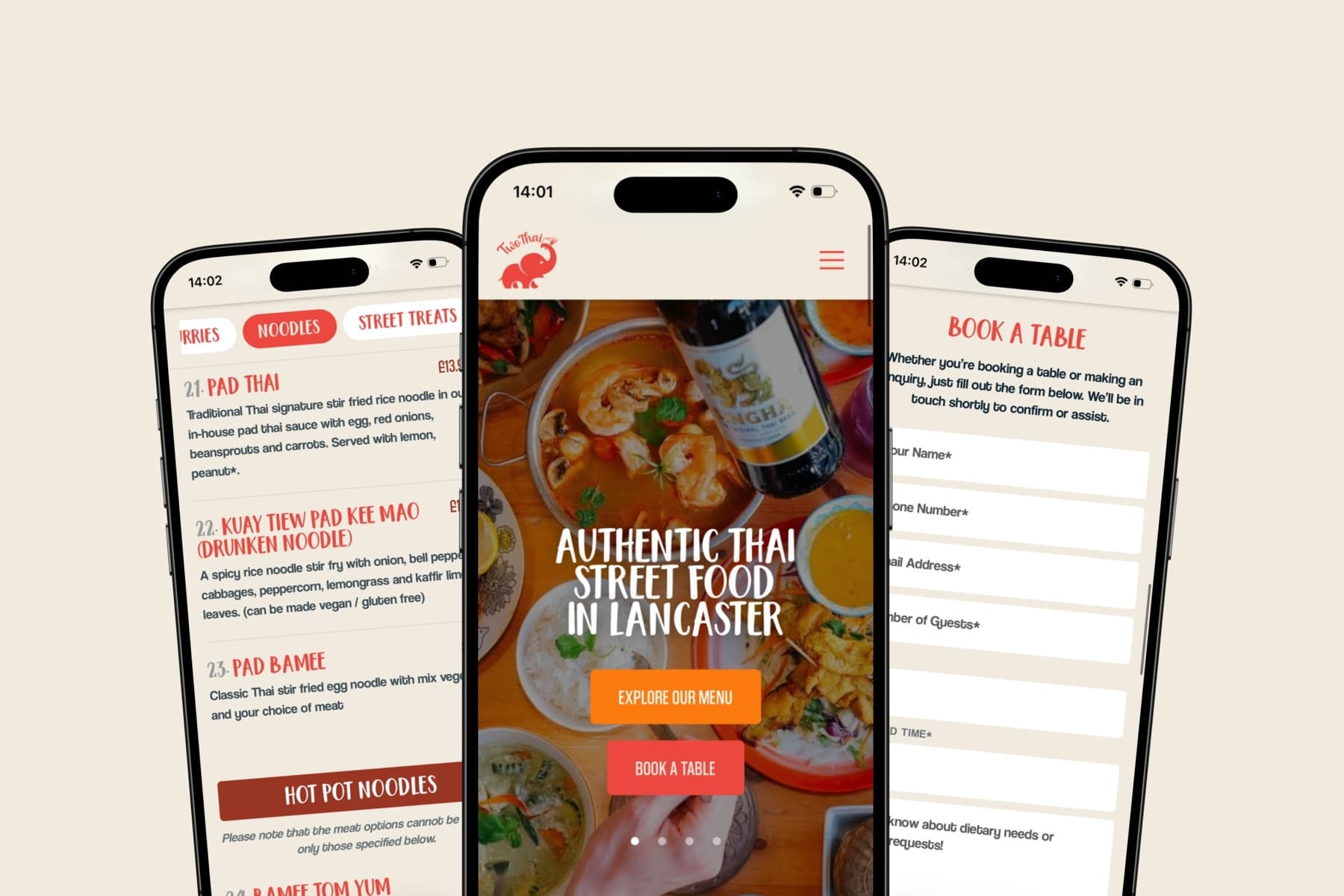
The menu is one page, divided into eleven sections that run from starters, salads and soups through curries, noodles and street treats to banquets, happy hour, drinks, wine and desserts. Dishes are numbered, as they are on the printed menu, so anyone ordering by phone can give a number and be understood.
Each dish carries its price and a description that explains what it actually is rather than repeating its name. Vegan and gluten free dishes are marked, and the ingredients people most often need to avoid are flagged against the dishes that contain them.
Asking for a table
Tables are requested through a short form that asks for the date, the time, how many people are coming and anything the kitchen should know about dietary needs, then the restaurant confirms. The same form handles general enquiries, so there is one thing to fill in rather than a choice to make first.
Delivery is handled by the service the restaurant already uses, linked from the main navigation, so somebody who wants food at home is one tap from it instead of hunting through a third-party app.
Room for the restaurant to talk
A news page gives the team somewhere to put events, new dishes and changes to opening hours, which they publish themselves. The address, the phone number and the opening hours sit on every page, and the social accounts where the restaurant is most active are linked throughout.
The look
The design takes its cue from the food rather than from restaurant convention: warm cream, coral and orange, hand-lettered display type, and the elephant from the restaurant’s own logo. Photographs of the dishes lead every screen, which is what sells a Thai menu to somebody who has not eaten there before.
The outcome
A site that does the three jobs the restaurant needs it to do. The full menu reads properly on a phone, a table can be requested in under a minute, and delivery is one tap away, with the kitchen able to change any of it without coming back to us. It is theirs outright, on a build with no platform sitting between the restaurant and its own website.
Thirty minutes, no charge. You will leave with an honest read on the problem and a clear recommendation, whether or not you work with us.